Showing posts with label South India. Show all posts

Sep 19, 2023

The Mysterious Abandonment of Dhanushkodi, Tamil Nadu: Unraveling the Curse

Nestled at the southern tip of India, where the Bay of Bengal meets the Indian Ocean, lies a place of haunting beauty and eerie history - Dhanushkodi. This ghost town in Tamil Nadu's Rameswaram district has captivated the imagination of travelers and locals alike for decades. Abandoned in the aftermath of a catastrophic cyclone and shrouded in a veil of mystique, Dhanushkodi beckons with tales of a forgotten past and a lingering curse that continues to haunt its desolate shores.
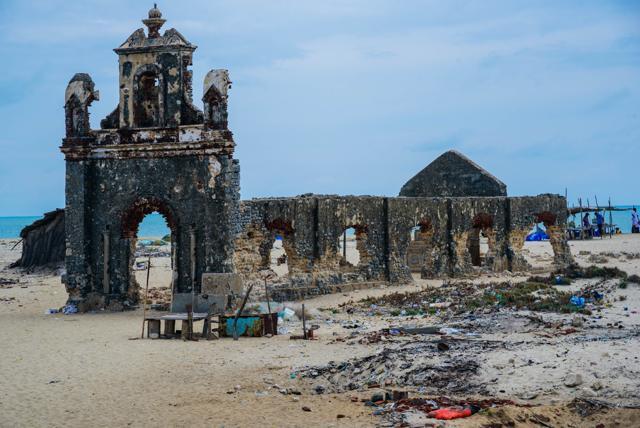
Dhanushkodi was once a thriving coastal town, a bustling hub of trade and pilgrimage. Its name translates to "End of the Bow," referencing the mythological bridge believed to have been built by Lord Rama to reach Lanka. The town's proximity to Sri Lanka made it an essential transit point for sea trade and devotees embarking on spiritual journeys.

Legend has it that Dhanushkodi's fall from grace was triggered by an unfortunate incident involving a revered saint. Devotees believe that a local fisherman, who was actually Lord Rama's devotee, informed the ruling king of Rameswaram about an approaching ship carrying precious stones from Sri Lanka. The fisherman's intention was to prevent the king from stealing the stones, but his actions inadvertently led to the ship's capture.

Furious at the betrayal, the saint cursed Dhanushkodi, prophesying its ruin and abandonment. The curse warned of a catastrophic cyclone that would wipe out the town, erasing it from the face of the Earth. This chilling prophecy eventually became a reality.

In December 1964, a powerful cyclone struck Dhanushkodi, leaving death and destruction in its wake. The storm surge engulfed the town, erasing homes, temples, and lives. The once-thriving settlement was reduced to ruins, and survivors were forced to flee, leaving behind a haunting reminder of the curse.

Today, Dhanushkodi stands as a ghost town frozen in time. The skeletal remains of buildings, dilapidated railway tracks, and half-submerged structures bear witness to the town's tragic past. The ruins are a poignant reminder of the power of nature and the legacy of a curse.

While skeptics may dismiss the curse as mere superstition, it's hard to ignore the uncanny alignment between the curse, the fisherman's betrayal, and the catastrophic cyclone. The intertwining of myth and reality adds an intriguing layer to Dhanushkodi's story, making it a destination of both historical significance and supernatural allure.

Despite its desolate appearance, Dhanushkodi has experienced a resurgence in recent years as a place of spiritual significance. Devotees and travelers visit to pay homage to the Rama Setu, the mythological bridge that spans the waters between India and Sri Lanka. The town's aura of mystery and its association with Lord Rama continue to draw those seeking a connection with the divine.

Dhanushkodi's tale is one of tragic beauty, a blend of history and myth that lingers in the salty breeze and whispers through the rustling leaves. As visitors tread lightly through its ruins, they bear witness to the remnants of a once-thriving town and the enduring legacy of a curse that remains etched in its sands. Dhanushkodi's abandonment is more than a physical decay; it's a testament to the potent interplay between human actions, nature's fury, and the enigmatic forces that shape our world. Whether seen as a cautionary tale or a testament to the resilience of spirit, Dhanushkodi invites us to ponder the delicate balance between destiny and choice that shapes the fates of both places and people.


Aug 25, 2023

Unraveling the mystery of Kodinhi: The Twin Village of Kerala

Kodinhi, a quaint village nestled in the Malappuram district of Kerala, has earned the intriguing moniker of "twin town." This small community, with approximately 2,000 families, has baffled researchers and captivated the world with its disproportionately high number of twins. This phenomenon has piqued the curiosity of scientists, locals, and visitors alike, making Kodinhi a subject of fascination and speculation. In this article, we will delve into the mysteries surrounding the twin births in Kodinhi, exploring the statistics, theories, and the ongoing quest for answers.
The Astonishing Statistics


Kodinhi's claim to fame lies in the astonishing number of twins born within its boundaries. While globally, twins comprise only 6 of every 1,000 live births, in Kodinhi, this figure skyrockets to a staggering 42 per 1,000 live births – a 700% increase. This makes Kodinhi an anomaly in India, where the average occurrence of twins is just four out of every 1,000 births. The village's twin birth rate is a remarkable 45 per 1,000 births.

The origins of the twin phenomenon in Kodinhi trace back to a period approximately 60-70 years ago. The trend started to emerge, and with each passing year, the number of twins has been steadily increasing. In fact, over the past decade, the number of twins in Kodinhi has doubled, leaving researchers astounded.

One puzzling aspect of the Kodinhi twin phenomenon is the correlation with the height of women in the village. Twins tend to occur more frequently in women who are generally over 5 feet 3 inches tall. Interestingly, the average height of women in Kodinhi is around 5 feet, which defies the established pattern observed elsewhere. However, the exact relationship between height and twin births in Kodinhi remains a subject of speculation.


Even those who marry outsiders and move away from the village seem to exhibit a substantially higher-than-normal rate of having twins. This adds another layer of complexity to the Kodinhi twin mystery. It appears that the twin phenomenon is not confined to the village itself but somehow follows those connected to Kodinhi, regardless of their geographical location.

The abundance of twins in Kodinhi has led to some amusing situations. Teachers find it challenging to identify the twins in schools, and even the local people sometimes face a similar predicament. Jokes circulate about newly-wed couples mistaking their partners for the other twin in the pair during the early stages of their conjugal life. The identity crisis caused by the prevalence of twins adds a touch of humor to the peculiarities of this unique village.

To celebrate the twin phenomenon and foster a sense of community, the residents of Kodinhi have established the Twins and Kin Association (TAKA). This association serves as a platform for twins and their families to come together, share experiences, and strengthen their bond. TAKA has become an essential part of the village's identity, further solidifying Kodinhi's reputation as the twin town.

Numerous experts and researchers have embarked on a journey to unlock the secrets of Kodinhi's twin mystery. Dr. Krishnan Sribiju, a prominent figure in the field, has been studying this medical marvel for the past two years. Although 220 sets of twins have been officially registered, Dr. Sribiju believes the real number to be far higher. His research has led him to speculate that the answer lies in something the villagers consume, but isolating the specific substance has proven elusive. Despite the lack of definitive answers, Dr. Sribiju remains committed to continuing his research, employing more advanced biochemical analysis equipment in his quest for a breakthrough.


Kodinhi continues to captivate the world with its extraordinary abundance of twins. The village's twin birth rate defies global and national averages, leaving researchers perplexed and curious. As the years pass, the number of twins in Kodinhi only seems to grow, fueling the quest for answers. While theories abound and research persists, the mystery of the twin village remains unsolved. Kodinhi stands as a testament to the wonders and enigmas that exist within our diverse world.

Aug 14, 2023

The Mystery of the Red Rain in Idukki: A Fascinating Phenomenon Explored

Have you ever heard of the strange phenomenon that occurred in Idukki, southern India, known as the Red Rain? It was a truly perplexing event that took place from July to September 2001, when heavy downpours of red-colored rain fell sporadically on the region, leaving residents bewildered and scientists intrigued. This article delves into the captivating mystery of the Red Rain, exploring its origins, scientific theories, and the implications it has for the possibility of extraterrestrial life.

During those fateful months, the skies of Idukki turned into a scene straight out of a science fiction movie. Witnesses reported raindrops that were not clear, but rather a vivid shade of red. Not only did the rain stain clothes, but it also burned leaves and left the water a gory hue. The sheer horror experienced by the residents is unimaginable.


The Red Rain event of 2001 was not an isolated incident. Scientific records indicate that Kerala and neighboring Sri Lanka have experienced sporadic instances of colored rain since the 1890s. The phenomenon, however, has not been consistently retained in local living memory. This historical context adds to the intrigue surrounding the Red Rain.

The baffling nature of the Red Rain prompted physicist Godfrey Louis from Cochin University of Science and Technology to investigate further. Collecting numerous samples of the red rain, Louis aimed to decipher the source of the contamination. Initial speculations suggested sand or dust from a distant desert, but microscopic analysis revealed a different story.

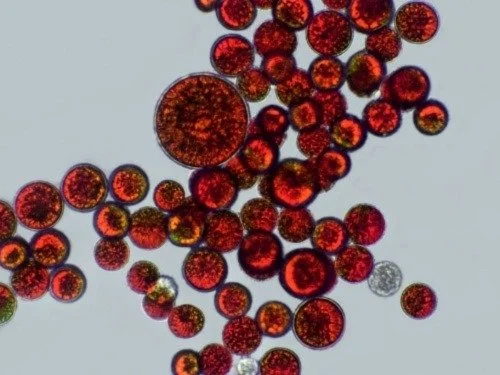
Under the microscope, Louis discovered that the rainwater contained red cells resembling conventional bugs found on Earth. What made these cells extraordinary was the absence of DNA, which would typically be present in most known biological cells. This finding raised intriguing questions about the origin and nature of these unusual entities.


In 2006, Louis published his groundbreaking results in the peer-reviewed journal Astrophysics and Space, along with a daring suggestion: the red cells could be extraterrestrial in nature. He proposed that a disintegrated comet in the upper atmosphere may have seeded the clouds, ultimately leading to the red rain phenomenon. This hypothesis caught the attention of the scientific community and sparked further investigations.

To fully understand Louis's extraterrestrial hypothesis, we must delve into the concept of panspermia. Pioneered by physicist Fred Hoyle and astronomer Chandra Wickramasinghe, panspermia suggests that life exists throughout the universe, carried by comets, asteroids, and interstellar dust clouds. According to this theory, life on Earth could have originated from one or more of these sources.

The investigation into the Red Rain phenomenon extended beyond the microscopic analysis conducted by Godfrey Louis. Samples were sent to labs in the United Kingdom, where microbiologists at Cardiff University meticulously studied the cells. After intense analysis, Chandra Wickramasinghe, working with the team, expressed growing conviction that the cells were highly unusual and did not contain DNA.

Supporting the extraterrestrial hypothesis, reports emerged of a sonic boom-like noise in the region during the time of the Red Rain. This phenomenon could potentially be linked to the disintegration of an object in the upper atmosphere. The sonic boom, combined with the absence of DNA in the red cells, added weight to the possibility of an extraterrestrial origin.

While the extraterrestrial hypothesis and the idea of panspermia provide intriguing explanations for the Red Rain, it is important to note that more evidence is required for broader acceptance within the scientific community. Independent verification is crucial to solidify these claims and shed more light on the fascinating mystery of the Red Rain.

The Red Rain phenomenon has sparked renewed interest in the search for extraterrestrial life. If the cells found in the rainwater are indeed of extraterrestrial origin, it would be a groundbreaking discovery, potentially indicating that life exists beyond Earth. Further research and exploration are necessary to uncover the truth behind this enigmatic event.


The investigation into the Red Rain has contributed to the field of astrobiology, which seeks to understand the origin, evolution, and distribution of life in the universe. By studying the unusual cells found in the rainwater, scientists gain insights into the possibilities of life existing in extreme conditions and the potential for life to be transported across vast distances.

The Red Rain phenomenon in Idukki remains an unsolved mystery that has captivated scientists and the public alike. The vividly colored raindrops, the absence of DNA in the cells, and the extraterrestrial hypothesis have all contributed to the fascination surrounding this event. While the scientific community continues to explore and analyze the Red Rain, one thing is certain: the quest to unravel the secrets of this phenomenon brings us one step closer to understanding our place in the vast universe.

The Mysterious Abandonment of Dhanushkodi, Tamil Nadu: Unraveling the Curse

Nestled at the southern tip of India, where the Bay of Bengal meets the Indian Ocean, lies a place of haunting beauty and eerie history - Dh...